
Meet the Members: Joseph Arruda
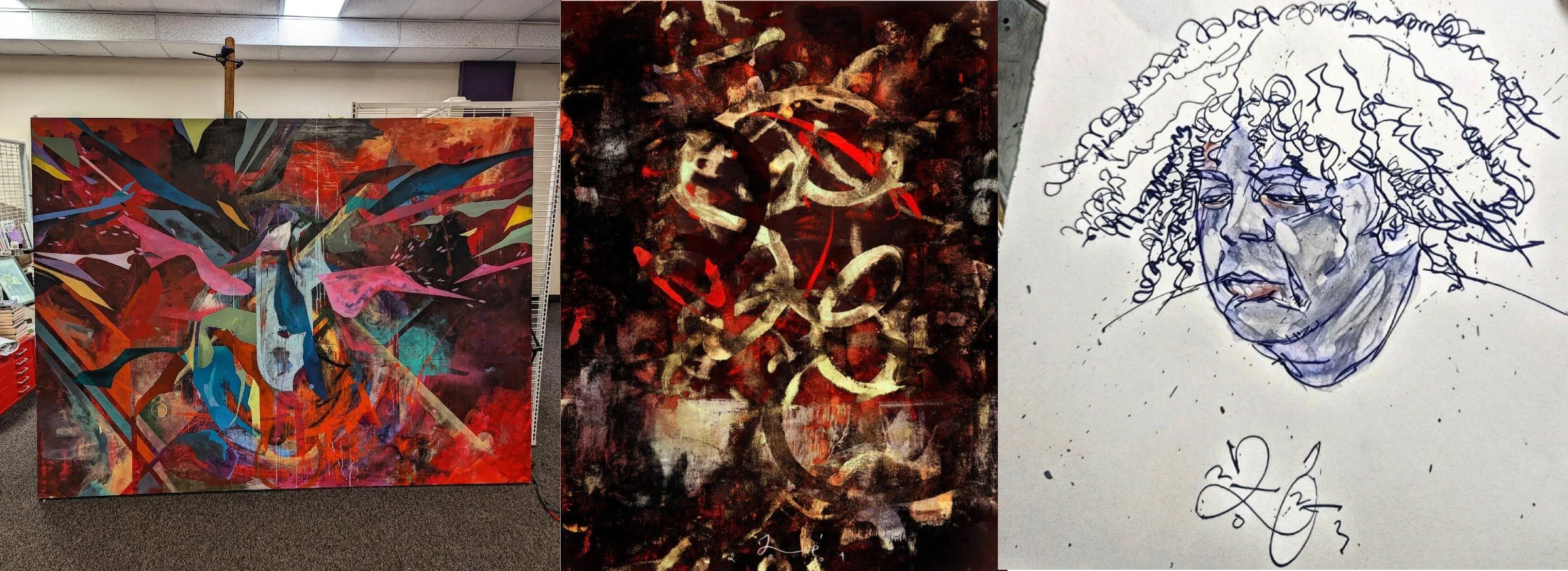
From L to R: Leviathan, Rising Deeper, and King Buzzo. All photos taken by Joseph Arruda.
Joseph Arruda is a visual artist based in the South Bay. Known for his stylized portraiture or abstract paintings, he’s worked on a vast repertoire of projects ranging from book sleeves to album covers. He also works with both analog and digital media.
Hi Joseph! Can you walk me through your creative process?
I work with a really weird combination of analog and digital. All my work starts in analog—I paint with pretty much anything that isn’t oil. I also remix my own work a lot. I sample my own stuff and then layer it on top of itself, so I end up creating things that occupy both spaces.
Was there anyone in particular who inspired you?
There’s not a single person, but I found that the artists that I kept gravitating towards as an influence all had the same [outlook]: “I’ve learned this stuff. Now I’m gonna throw that stuff out the window and I’m gonna do this.” You learn as much about their attitude as you do any specific technical thing they do; There’s a comic book artist named Bill Sienkiewicz, there’s a movie and music video director named Mark Romanek, and there’s a whole bunch of other names—Andy Warhol, Basquiat—these are people who all seem to go, “I’ve got a basic idea of what I want to do, but I also want to experiment with stuff.”
How do you think your art style has evolved?
In terms of my art style, I’ve only aggregated more stuff. I didn’t do abstract art until well into my 20s. I started using digital a long time ago, but I didn’t add it as a serious mix until some years later. Working in Local Color, you pick up more things that you add to your toolbox. If you’re really open about it, it just gives you more things to play with and you can leverage them as you see fit.
Did you have a studio space before your current one at LC?
No. I lived briefly in a house on the Peninsula where I had a studio space, but it was still pretty compact. Up until Local Color, I wasn’t really interested in joining a studio group or art collective. Historically, when I saw one, they would be very narrow– "Oh, this is a plein air group,” or, “This is a graf group.” I fit in multiple boxes, so when I got introduced to Erin Salazar and the group back when they were at the first location, I [thought], “This is very different. This is very exciting.” Then the opportunity came to get a seat at the table. It’s been great so far.
How has having a studio space helped propel your arts career?
Having a physical space is intrinsically conducive to being able to create whenever I want to. It’s safe and comfortable, the lighting is good, you get everything you need in it. And the close proximity to other creative people makes it easier to do certain projects.
When I did a mural at the Petiscos restaurant on S. First Street, I worked on it with Ben [Henderson]. I had never really done a mural of that size, so being able to contact Ben, who’s part of the overall group, to go, “You know about this stuff. Help me out,” to work out an actual project and then deliver it… that’s one of those things, where if I was just on my own, it probably would’ve been a much more difficult hill to climb.
Do you have any advice for other creatives?
Don’t be scared to screw up and experiment. There’s reasons sketchbooks exist. Screw up all you want. You can either try to figure out how to fix your mistakes or you just start over, and there’s nothing wrong with that.
The other thing is don’t be scared to talk to other people, online or in-person. Part of the Local Color appeal was being able to walk to any of these different creative people and ask, “How would you tackle a problem like this,” and have them go, “Never thought of that,” or sometimes you get lucky and they say, “I’ve done something like that,” and they tell you. Nothing wrong with not knowing. Just ask.